
Main navigation menu
A well-designed main navigation menu is essential for helping users quickly locate and access key sections of your website. It enhances usability, supports accessibility, and contributes to a positive user experience by making the interface intuitive and easy to explore.
You can select the menu to display in the Header settings pane.
Learn how to create an accessible menu.
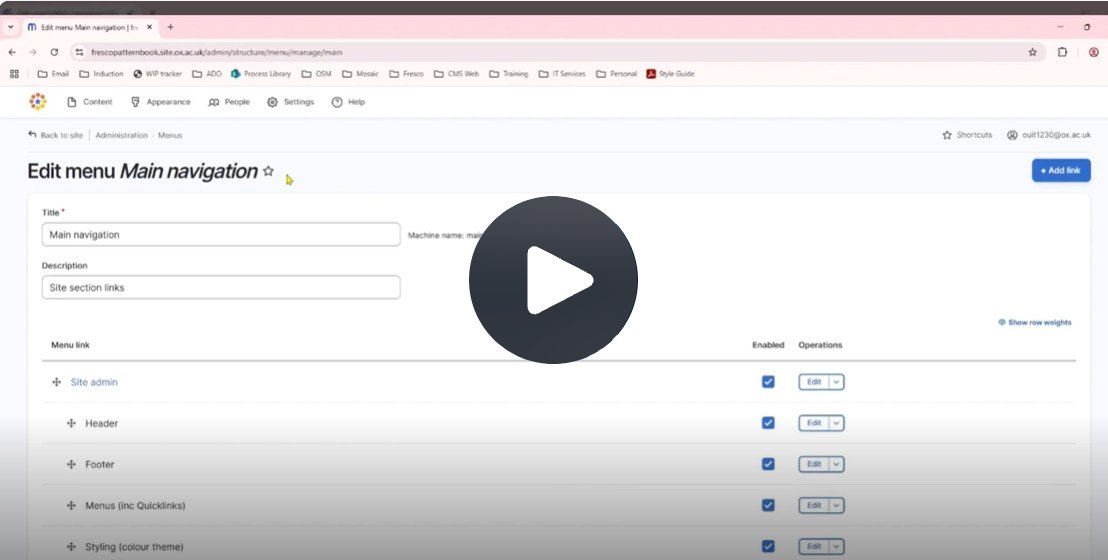
Click Fig. 1 image to view the video on SharePoint Online. Available to users who are logged in to our organisation’s intranet
Adding a link to the menu
- Go to Settings > Menus and then select ‘Main navigation’ and click ‘Edit menu’.
- Click 'Add link'.
- Enter short but descriptive link text.
- Choose whether it should be an 'Active' link (i.e. a clickable link) or just a button that reveals child items.
- Start typing the page name to create the link and select the page from the drop-down list.
- Select 'Enabled' if you want it to be visible in the menu.
- Select the ‘Parent link’ to position the link in the menu. Please note:
- The menu has a fixed number of levels in the hierarchy so if you reach this limit, you may not be able to add additional links.
- If you’re adding a link to a top-level page, the parent link should be <Main navigation>.
- Adjust the display settings and add a hover description. Both are optional.
- Click ‘Save’ to return to the menu.
Editing a link
- Find the link in the menu and click ‘Edit’.
- Make your changes in the edit screen (follow the instructions above).
- Click ‘Save’ to return to the menu.
Rearranging links
- Use the drag-and-drop arrows to the left of the link name on the menu page.
- Drag up and down to move a link up and down in the menu hierarchy.
- Drag left to right to nest items under a parent.
- ALWAYS save your new order before editing or adding more links
- Alternatively, go to the edit screen and use the 'Parent link' drop-down list.
Deleting a link
Choose one of these methods:
- Click on the drop-down arrow to the right of the link and select ‘Delete’.
- Click ‘Edit’ and use the red ‘Delete’ button at the bottom of the page.
You’ll be asked to confirm the deletion.
Creating an accessible menu
To ensure your navigation menu is intuitive and accessible, it’s important to follow best guidelines.
- Use clear, concise labels that accurately describe the destination.
- Avoid jargon, abbreviations, or overly clever names.
- Limit the number of top-level options (ideally to 5-7) to avoid overwhelming users.
- Organise items in a logical hierarchy that reflects how users think about your content.
- Group related items together under meaningful categories.
- Place the most important or frequently accessed items first.
- Avoid changing the order or labels of menu items unless necessary as this could result in broken links on your site or from other websites, email, documents, etc.
Testing your navigation menu with real users is a useful step in ensuring its effectiveness.
- This will help to identify pain points, ensure they can find key content easily, and validate that the structure and labels are clear and intuitive.
- Try free tools like tree testing or card sorting from sites such as Optimal Workshop or Useberry.
Related information
Changes may have been made to enhance this feature since we last updated this page. See What’s new for the latest release information.
Last updated: 17 July 2026